Pages

Saturday

Typical Cost when you Tour Panama


So, how much does it cost living or just even touring on Panama? This could be the most trending or important question upon planning a tour on vacation. Because we know that going to a place we’re unfamiliar of is a risky thing to do and we must be very prepared especially when it comes to finances. It’s real hard to run out of money in a foreign land.


In 1914 when the Panama Canal was constructed, the country has been a very important when it comes to international shipping industry. Since then, the country became a famous tourist destination for tourist and retirees due to cheaper American flights. But then, the cost of living in Panama is still higher than that of other countries in America like Nicaragua. 

Here are some of the usual prices that you can get for services offered:

Room accommodations. Throughout Panama, the average budget room rate is around US$10-20 for a single night. On the other hand, if you are looking for a private room, prices start at US$25. For the past few years, several hotels in places in Panama offered room accommodations at a very low price, even less than $10. Renting houses in Boquete for long periods of stay are also popular.

Transportation. Buses and taxi rides come at a reasonable price. In fact, a trip around the country by bus will cost you around $10-20, while overnight ones cost $25. If you are a thrift rider, you’ll just probably travel a day in Panama by around $20-$30. 

Food. Food is indeed one of the major reasons for spending on a trip. As for Panama, restaurants are serving comida corriente or set meals wherever you are for just about $2-$4. This serving usually comprises of rice, chicken and beans. However, if you want a more class cuisine with wine, expect to pay $30-40.

As for a tip, you’ll get the most of your money in Panama if you’re going to share the expense with others. For an instance, a double room is definitely cheaper than that if you’ll have it alone. Excursions and hikes are also cheaper for groups. Another is to make sure that the room you have rented does not have hot water showers. The climate in Panama is usually hot that’s why hot waters are of no use. Besides, it’ll just cost you extra price.

Image credits: destination360.com

The Panama Canal Expansion Project

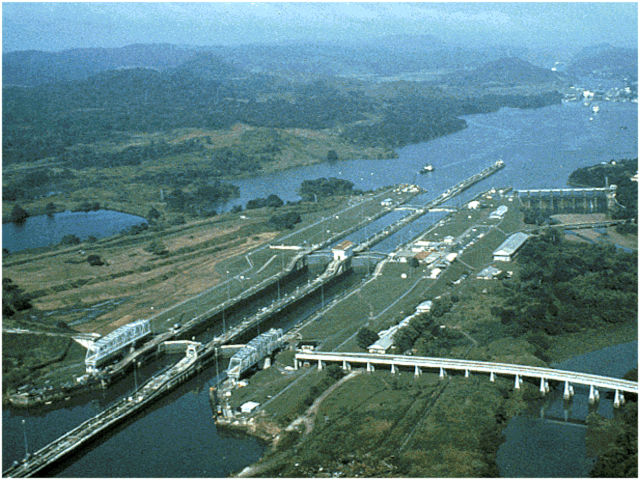
The Panama Canal Expansion Project (also called the Third Set of Locks Project) will double the capacity of the Panama Canal by 2015 through creating a new lane of traffic and allowing more and larger ship to transit.


The project will build two new locks, one each on the Atlantic and Pacific sides. Each will have three divisions with water-saving basins. Excavate new channels to the new locks. Widen and deepen existing channels. And raise Gutan Lake’s maximum operating level.

The project is expected to create demand for ports to handle post-Panamax ships. As of November 2012, the U.S. Eastern Seaboard ports of Baltimore, Maryland; Norfolk, Virginia and Miami, Florida, will be ready for these larger ships, although other ports are considering renovations, including dredging, blasting and bridge-raising. 

The construction of the third set of locks project is scheduled to take seven to eight years. The new locks could begin operations between fiscal years 2014 and 2015, approximately 100 years after the canal first opened.

The International maritime industry will benefit directly from the expansion through lower shipping costs, and global consumers will eventually benefit from the greater capacity and efficiency of the said project. 

Navigational channels. According to the plan, a 3.2 kilometer long access channel will be excavatedto connect the New Atlantic locks with existing sea entrance of the canal. To connect the new Pacific-side locks with the existing channels, two new access channels will be built: the north access channel, which will connect the new Pacific-side lock with the Culebra Cut, circumventing Miraflores Lake, and which will be 6.2 km long and the south access channel, which will connect the new lock with the existing sea entrance on the Pacific Ocean, and which will be 1.8 km long.   

Estimated cost. The ACP estimated the cost to construct the third set of locks at US $5.25 billion in 2006. This figure includes design, administrative, construction, testing, environmental mitigation and commissioning costs. It also includes contingencies to cover risks and unforeseen events such as accidents, design changes, price increases and possible delays. 

Environmental impact. According to ACP’s proposal they claim that the project will not permanently harm the environment, communities, primary forests, national parks or forest reserves, relevant patrimonial or archeological sites, agricultural or industrial production areas, or tourist or part areas. The project will not permanently reduce water or air quality. The water capacity of Gutan and Alhajuela Lakes will maximize the water supply program. And it design to use water so efficiency at the locks that no new water reservoirs will be required and no communities need to move.

Image credits: constructiondigital.com

Friday

Arthropod Species in Panama Rainforest

Panama has a large land and in this land you’ll not only enjoy the different sights like beaches and forests as you go on Panama tours, but you can also have a closer look on their animal species. 

In the most comprehensive and through studies done from the rainforests of Panama provides a new level of detail with regards of the variety and distribution of arthropod species from the soil to the forest canopy. There are about 6,000 estimated hectare forest hosts a total of around 25,000 arthropod species, 60% to 70% of which are likely to be previously unknown.

Most of the species existing on Earth are arthropods - an invertebrate animal having an exoskeleton, a segmented body, and jointed appendages; such as insects, mites and spiders living in tropical forest. Researchers have struggled to quantify their abundance and diversity because of their small size, frequent movements, and inaccessible habitats. Due to massive collaborative effort involving 102 researchers from 21 countries was necessary to collect and identify arthropods from all parts of the San Lorenzo forest resources near the Atlantic entrance to the Panama Canal. In 2003-2004, the field team used 70 person or trap-years in sampling the rainforest canopy from a construction crane, on inflatable platforms, from hot-air balloons, climbing ropes and crawling along the forest floor to sift soil and trap and drag arthropods. As the result, the team sorted and identified 130,000 arthropods, to a total of more than 6,000 species.

By scaling up diversity values and conclude their known data, the researchers estimated the rainforest reserve harbors in excess of 25,000 arthropod species. That means for every species of vascular plant, the bird or mammal in this forest, you will find 20, 83 and 312 species of arthropods respectively. 
One of the most interesting findings was that more than half of all species could be found in a single hectare of the forest. This means that to determine the species variety of a tropical rainforest, it may not be necessary to sample massive areas. One hectare area is enough to get an idea of regional arthropod richness - provided that this total includes widely spaced plots representative of variation within the forest.

Another exciting finding was that the variety of herbivorous and non-herbivorous arthropods could be accurately predicted from the diversity of plants.

So next time you visit the place and plan your next Panama excursions, you can opt to take a scientific tour as to seeing the smallest life forms in their rainforests.

Saturday

About Gamboa Panama


The little town of Gamboa in Panama is a forty-minute drive away from Panama City, but unlike the latter, Gamboa feels just so remote due to the fact that it is closer to nature. This town is constructed by the Panama Canal Company in the early 1930s to provide shelter for the workers of the Panama Canal Dredging Division.


The Past

In the history Gamboa was built nearly in the former village of Sta. Cruz, were three miles the Chagres River was the town of Las Cruces. In 1855 after the completion of the Panama Railroad which ran near the Panama area, yet made no stops and no PR maps list any towns in its present location.

During canal construction Gamboa’s present day was built in 1911. The town was populated by “silver roll” workers and their dependents. Almost 700 initial settlers were previously lived in the construction areas between Gorgona and former towns of Tabernilla. Together with the towns first citizen, no Americans were counted.

Along 1914, Gamboa’s population decreased to 173 which consist of a police station, a four-family house, a two-family house and some old railroad box cars used by the house silver roll employees. 

After long years of studies and debates, Panama Canal Company moved its Dredging Division from the town of Paraiso to Gamboa in 1936. In 1933, due to the moving of Dredging Division to Gamboa, the population was 251, including just 10 Americans.

The Present

In present time Gamboa is still inhabited, but with a shadow of its old self. It remains the original headquarters of the Dredging Division of the Panama Canal Authority (formerly PCC).

The Dredging Division’s harbour is now used by light ferries to reach the Smithsonian Tropical Research Institute (STRI) facilities at Barro Colorado Island.

Caymans, iguanas, crocodiles and several hundred bird species are Gamboa’s residents. Gamboa is bordering to relevant tracts of undisturbed rainforest. The Pipeline Road is considered one of the best birding hikes in Panama.it is also one of the premiere bird watching sites in all of Central America.      

Image credit: www.elitemeetings.com

Panama Destination Highlights

Take a break, discover and experience all the breathtaking highlights of Panama; the Panama City, San Blas Islands, Chiriqui Highlands, Bocas del Toro and Panama Canal. 

Panama City 

Perfectly positioned along Northwest Florida’s Emerald Coast which provides an easy access to several fascinating beaches where you can try their varieties of water sports, fishing and boating. In fact, the whole region is one of a family favorite destination not only with their beautiful beaches, hotels, its amusement parks and of course, the freshest seafood available anywhere. And don’t forget the historical town of Casco Viejo, a colonial style government buildings, museums including a Canal Museum and cathedrals. 

San Blas Islands

The San Blas offers a show of sights. Starting with the unbelievable seascapes, colorful reefs and islands which owned and operated by the Kuna Indians. Also the visitors can witness the glimpse of the culture with their continuous festivals and gatherings develop at villages. The tour includes the opportunities to go snorkeling to enjoy the beautiful reefs and variety of tropical fish in the shallow warm waters.

Chiriqui Highlands

A two hour drive from Panama’s northernmost city, David to visit the Panama’s highest peaks Baru volcano, and some of its longest rivers found only in Chiriqui Highlands. The cool climate is one of the main attraction welcoming the visitors from the hot and humid lowlands. One of towns with the best accommodation is Boquete with the great base for exploring the area, well-known for its orange and coffee plantations where you can learn about the coffee process. Enjoy your stay with the opportunities to go walking in the cloud forest, bird watching and white-water rafting. 

Bocas del Toro

Panama’s number one vacation spot between the archipelago of Bocas del Toro. Visiting key areas like Hospital Point, a whole day snorkeling or beachcombing and enjoy an outdoor lunch. Also try these scuba dive in bio-diverse waters or go kayaking. Tired of these whole day activities? Try to spend the night and relax at this lovely hotel, built on stilts above the water the Punta Caracol.

Panama Canal

Linking the Atlantic and Pacific which cuts right trough the Continental Divide, one of the world’s greatest shortcuts, the Panama Canal. Continue your trip to Portobello, with its lovely spot hides the historical fort where Francis Drake was killed.

Image credits to:

Friday

Bits and Facts about the Culture of Panama


Learning about something soon develops to love. As for you who want to learn something or maybe everything about the country of Panama, for sure you’ll never be disappointed. Panama has a lot of bits and stuffs to catch your interest.

Panama is a nation of rich heritage. This richness of culture and history is brought by the mixture of people, literally. In the country you can find traces of Indians, Cuna and Guavmi blended together to form the present Panama. Not just that, aside from the mentioned groups throughout history, the Spanish settlement in Panama also created a great influence. It has been said that the presence of visitors throughout time brought Panama to where it is right now. 


The People

Imagine a small strip of an island inhabited by different people of various cultural origins. With a population of not more than four million, almost 70% of it are mestizos and mulatos. There are blacks, whites, Amerindian and indigenous people bound together living in harmony. A tribe in Panama, the Cuna is very known for its close ties and matriarchal societies or those headed basically by women members of the family. Their official language is Spanish, so bring with you a lot of Spanish conversations as you plan to go.

As you go to different places in Panama inhabited by varying indigenous groups, you can feel the warmth and friendliness of the people. These groups each possess a unique quality within them, and also, held individual celebrations representing their rich cultural history. The Panamanians are also known to be skillful craftsmen. They are able to produce jewels and other crafts also of rich ancestral origin. Though they tend to be different in origin and customs, Panamanians are bound together by the value of peaceful and harmonious living.

Panamanian Religion and Cuisines

Roman Catholicism is the most dominant religion in the country of Panama. In fact, most of the traditions and celebrations are held in honor to saints. For example, a big celebration in Panama is the Black Christ Festival. Another example of how saints affect the life of every Panamanian is that they consider them to be the owner of every town. 

The cuisines all over Panama are affected by cultural variations and the location of the country. But mostly, the foods are American and Spanish in style. Famous dishes are Carimanola, Tamales, Empanadas, and Tortillas among others. Panamanians also include a lot of sea food in their dishes since the country is in a coastal region. 


Sunday

Processed Food Contributes to Massive Rainforest Destruction


Are you surprised about this one? Maybe for ‘not so environmental persons’, this fact is a strange one. Usually, when we talk of rainforest destruction, we think of the usual destructing factors—logging to be used for coal or fossil fuel and rainforest fires caused by human negligence. 

It is so common to hear about rainforest degradation. Hundreds or even thousands of acres lost per year. As for us, who are living far away from natural rainforests might think that we are not responsible for this; thinking we have no any direct access to this so how can we destroy them? But as we look clearly, we are involved to this, just indirectly. We might not be aware how our everyday activities affect the current status of our rainforests. Just like this one, who knows that even processed foods that we eat almost if not every day, could be a great factor to rainforest destruction?


Palm oil as the key suspect. We might not know this, but palm oil has been secretly a part of our everyday lives. Palm oil is a primary ingredient in most of our daily necessities – biscuits, soap, shampoo, and even fuel. Not just that, there are plenty of processed food products that contains palm oil as its key ingredient. But how does the use of palm oil causes deforestation? As we know, palm oil is extracted from coconuts, meaning it takes huge coconut plantations in order to generate such amount of palm oil to support our everyday living. In relation to this, rainforests are being cleared off to give way to these coconut plantations. Imagine every commodity in a supermarket with vegetable oil in its ingredient that is probably from palm oil plantations. Take a moment to think about how many forest trees are cut down just to plant coconut trees for palm oil.

At present, there are only few substitutes offered in replace for palm oil in the market. Some suggestions would be the use of margarine or vegetable oil from sunflower to reduce the consumption of palm oil, and in turn, lessen deforestation. 

The soy bean oil and refined wheat flour as secondary culprits. Processed cookies and crackers are really great for immediate need for food right? Did you know that these foods contain additives like soy bean oil and refined what flour that also accounts for deforestation? As a response to the increasing demand for these products, more and more forests are turned to soy and corn plantations. Not just that, the meat of animals we eat is also responsible for this problem. Soybean crop is used primarily for livestock feeds used to support agricultural businesses. 

With all these in mind, let us all be smart and remember how our daily actions are continually killing our natural rainforests.